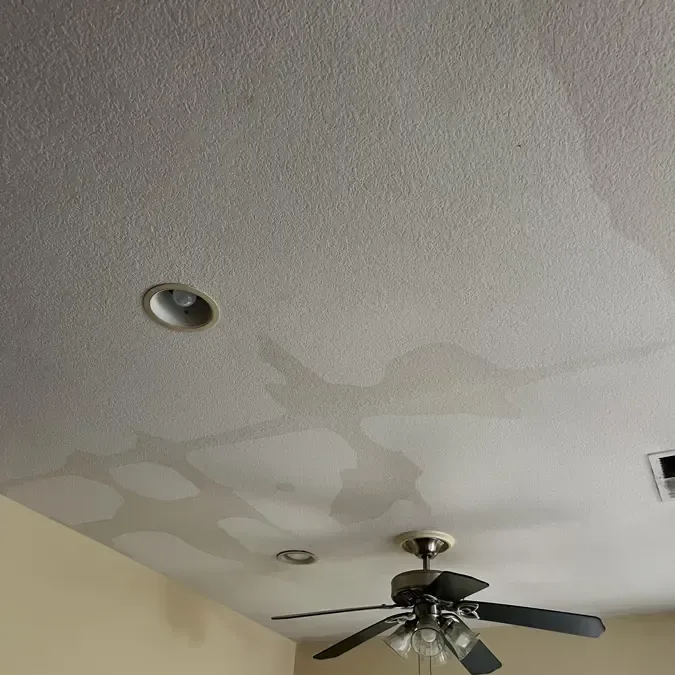
On November 10, 2024, an EF-0 tornado crossed into the village. Wind of that strength does not flatten buildings, but it can lift roofing, strip siding and loosen fascia, and rain finds those gaps long after the storm has passed.
Key takeaways
- A National Weather Service survey rated the November 10, 2024 tornado an EF-0, with estimated peak winds of 70 mph.
- The survey found small tree and large limb damage, lost roofing material on several facilities and minor siding and fascia loss.
- Minor wind damage can still open a path for rain into attics, ceilings and wall cavities.
- A stained ceiling or damp insulation after a storm is a reason to open and check, not to wait.
- A roofer closes the opening, and the restoration crew removes and dries what the water reached.
What the November 2024 tornado did
A National Weather Service survey rated the tornado an EF-0, the lowest rating on the tornado damage scale, with estimated peak winds of 70 mph. It began in wooded marshland southwest of Holly, moved northeast into the Village of Holly and ended east of the center of town near Martha Street and Washington Street.
The survey found small tree and large limb damage, loss of roofing material on several facilities, construction site damage and minor siding and fascia loss.
The damage ran along portions of Tenny Street, Locke Street, Legrande Street, Sherman Street, Saginaw Street, Church Street, Martha Street and Washington Street.
Wind again in May 2025
On May 16, 2025, another National Weather Service survey found a swath of uprooted and downed trees from downtown to a mobile home park, with winds estimated up to 70 mph.
Two wind events in about six months are a reminder that roofs and siding take repeated stress, and that small damage from one storm can become a leak in the next.
Why small wind damage becomes a water problem
Roofing, siding and fascia keep rain out of a building. When wind lifts a few shingles or strips a section of siding, the gap is small, and water gets in slowly.
Water that enters at the edge of a roof runs along the sheathing and rafters, soaks insulation and shows up in a ceiling far from the opening. By then the damage is wider than the repair.
- Lifted or missing shingles and loose flashing.
- Siding pulled away from the wall.
- Fascia or soffit boards loosened at the eaves.
- Branches that scraped or punctured roofing.
- Rain that falls days after the storm and finds the opening.
When a limb is the opening
Small trees and large limbs were part of the damage the survey found. A limb that lands on a roof can crack shingles or punch through the sheathing, and one that only scrapes can still loosen flashing.
The break may hide under leaves or snow, so the first sign is often the stain inside rather than the hole outside.
- Shingle pieces or granules in the gutters after a storm.
- A torn or lifted roof edge near a fallen limb.
- Daylight showing through the attic roof boards.
How rain shows up inside
The signs often appear after the next rain, not after the storm itself.
Attic and insulation
Wet insulation looks darker and clumps together, and it holds water against the framing. It is removed, because it does not dry quickly.
Ceilings and walls
Stains that spread after each rain, bubbling paint and a sagging ceiling all point to water above. A sagging ceiling can drop, so people stay clear.
- A brown ring that grows larger after rain.
- Peeling paint near an exterior wall.
- A damp smell in a top floor room.
The first steps after a wind storm
A roofer closes the opening. The restoration crew deals with the water that already got in.
The two jobs go together.
- Look from the ground for missing shingles, flashing and siding.
- Check the attic and the top floor ceilings after the next rain.
- Cover openings with a tarp or sheeting when it can be done safely.
- Photograph the damage before any repair or cleanup.
- Call for roof leak water damage cleanup when water is already inside.
- Do not climb onto a wet or storm damaged roof.
What a tarp does and does not do
A tarp keeps rain out of the opening until the roof is repaired. It does not dry anything that is already wet.
Wet insulation and framing stay wet under a covered roof, so the drying work still has to happen, and a tarp that traps moisture inside can make it worse.
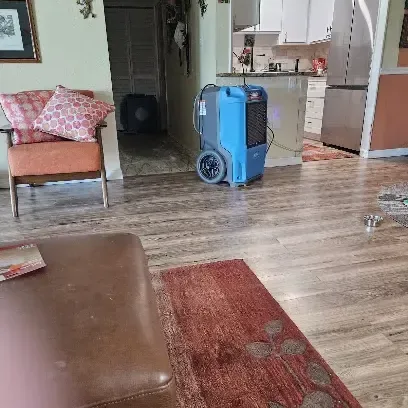
What the drying work covers
The crew finds the wet path with moisture meters, from the opening down to the lowest wet material. Water extraction comes first if any water is standing.
- Wet insulation is removed.
- Stained drywall is opened and dried or removed.
- Framing is dried with air movers and dehumidifiers.
- Readings repeat until each area reaches the dry goal.
- Finished surfaces are replaced after drying.
Older brick buildings and mobile homes
About 643 of the village's housing units date from 1939 or before, and about 309 are mobile homes. Drying plans follow the building type and age.
In downtown Holly, brick buildings replaced the wooden ones after 1875, and several still stand. Structural drying is planned around each building, not around a template.
Newer and older buildings take the same wind differently. A mobile home, a downtown brick storefront and a recent house each take on water in their own way, and the drying plan reads each one on its own terms.
The village has about 2,597 occupied homes, of which 1,842 are owner occupied and 755 are renter occupied. Tenants tell the landlord and owners tell the insurer, and both need photos taken before the first repair.
Records for the claim and the repair
Wind damage is easier to document on the first day than the tenth. A clear record also helps a roofer and a restoration crew work from the same facts.
Weather dates matter too. The November 10, 2024 survey and the May 16, 2025 survey both give dates that tie a roof problem to a storm.
- Dated photos of the roof, the siding and every interior stain.
- The date of the storm and the first date water was seen inside.
- The roofer's notes, estimate and photos of the opening.
- Moisture readings and the dates drying began and finished.
- Receipts for tarps, temporary repairs and cleanup.
Questions
Can an EF-0 tornado cause roof damage?
Yes. The National Weather Service found lost roofing material on several facilities, along with minor siding and fascia loss.
How long after a storm can a roof leak show up?
Water can enter at a small opening during any rain after the storm, so stains may appear days or weeks later.
Should wet attic insulation be dried?
Usually it is removed. It holds water against the framing and dries slowly.
Who fixes the roof and who dries the house?
A roofer repairs the opening. A restoration crew extracts water, removes wet materials and dries the structure. The two jobs are separate but should be coordinated.
Is a sagging ceiling dangerous?
It can be. Water collects above the drywall and can bring it down, so people stay clear until a crew opens it.
What should be photographed after wind damage?
The roof and siding from the ground, every interior stain, any fallen limbs and the weather date. Photos are taken before a tarp goes on or anything is thrown out.