Water Extraction and Removal in Holly
Water left standing keeps soaking into floors and walls, so the crew brings truck-mounted and portable pumps, pulls the surface water out and starts drying whatever it reached, from carpet pad to wall bases.
(888) 612-9219Call for pumps and extractors now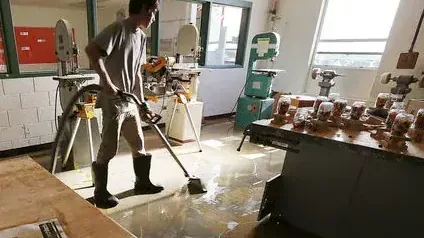
First steps for water extraction and removal in Holly
Stop the supply
Close the valve feeding the leak, and keep wet-room breakers off.
Lift what you can
Raise furniture onto blocks and move rugs and papers to dry rooms.
Photograph the water
Take wide and close photos of the depth, damaged items and source.
Leave the pad alone
Dragging soaked carpet pad around spreads moisture into dry rooms.
How a water extraction and removal job is handled
Readings before equipment
The tech who does the walkthrough checks walls, floors and the basement slab with pinless meters and thermal imaging before a single fan is placed.
Dried to IICRC S500
The drying team follows IICRC S500, the industry drying standard, so framing and subfloor get structural drying, not a surface wipe.
A file the adjuster can follow
Moisture maps, daily logs and timestamped photos go into one claim file from the first visit to the last reading.
Built for Michigan winters
Frozen pipes, ice dams, snowmelt seepage and sump pumps that quit in a storm are routine work across Livingston County.
What does water extraction and removal cost in Holly, MI?
Extraction alone usually costs $300 to $2,500, and adding full drying brings a typical job to $1,200 to $5,000. The final figure depends on water depth, floor area and whether carpet pad must be removed or can stay.
One room or hallway
$300 to $900
- Portable or truck unit
- Carpet floated if pad survives
- Surface moisture checked
Basement or several rooms
$900 to $2,500
- Truck-mounted extraction
- Pad pulled and bagged
- Submersible pump if deep
Extraction plus full drying
$1,200 to $5,000
- Pump-out and removal
- Air movers and dehumidifiers
- Daily readings for the claim
Ranges are typical, not a quote: water category, wet square footage, material class and how fast drying started move the number most. Run the water damage cost calculator for a closer planning range.
The water extraction and removal process, start to dry
Four stops, run in this order, with a reading logged at each one.
- 1
Assess and map
A technician finds the source, tests the water type and maps wet areas with a meter and thermal camera.
- 2
Extract the water
Pumps and extractors pull standing water off floors and out of carpet until the surface is damp.
- 3
Remove and protect
Soaked pad is bagged, furniture is blocked up and wet baseboards are pulled so air can reach the cavity.
- 4
Hand off to drying
Air movers and dehumidifiers go in, and readings are logged each visit until the structure is dry.
Extraction comes first because water that is removed never has to be dried. Housing in Holly runs from 643 units built in 1939 or earlier to 92 built in 2020 or later, and downtown has historic brick buildings, so the crew starts by finding the source in whatever building it is.
How extraction works on a wet floor
- Standing water is pumped off hard floors and slabs with truck-mounted or portable units.
- Carpet is floated or extracted in place when the water was clean and the pad can still be saved.
- Saturated pad is pulled and bagged, because it holds water long after the carpet surface feels dry.
- A submersible pump handles anything deeper than a few inches.
- Moisture meters check the subfloor and wall bases before drying equipment is placed.
When the water is not clean
Water from a toilet overflow, a floor drain or a flooded yard is not simply pumped out. It is treated as contaminated, so porous materials it touched are removed and hard surfaces are cleaned and treated before anything is dried.
Extraction is only the first half of the job. A pumped-out structure still holds moisture in framing, subfloors and insulation, so the crew moves straight into structural drying with air movers and dehumidifiers.
Where pumping stops and drying starts
A pump cannot reach water inside a wall cavity or under a floor. Thermal imaging and meter readings show where moisture remains, and the drying plan is built from those numbers, not from how dry the carpet feels. The main water extraction page lists the full process step by step.
Water Extraction and Removal across the surrounding area
Crews work across the village, from Downtown Holly and Battle Alley to the Saginaw Street, Martha Street and Church Street areas, around Mill Pond and WaterWorks Park, and throughout ZIP code 48442.
The same service nearby: water extraction and removal in Howell, Fenton, Milford. Every water service for this town · every town covered
Related water damage services nearby
Water Extraction and Removal questions in Holly, MI
How soon does extraction need to start?
Sooner is better, because water spreads into pad, baseboards and framing the longer it sits. An early call gives the crew the best chance of drying carpet and cabinets instead of replacing them.
Can carpet be saved after extraction?
Often yes, when the water was clean and the pad is lifted or replaced. Carpet that sat in gray or black water is usually discarded.
What is the difference between truck-mounted and portable units?
Truck-mounted units have the most suction for large wet floors. Portable units go upstairs, into tight rooms and anywhere a hose cannot run.
Does extraction leave the building dry?
No. It removes surface water only, so air movers and dehumidifiers run afterward until readings match a dry area of the same building.
Does the age of a Holly house change the work?
The method stays the same, but older flooring, plaster and wood may dry more slowly. Homes here include 643 units built in 1939 or earlier and 92 built in 2020 or later.
What should be moved before the crew arrives?
Small furniture, rugs, papers and electronics should go to a dry room if that is safe. Heavy pieces can stay while the crew blocks up the legs.
Pull the standing water out before it spreads further
A crew can bring pumps and drying gear to a Holly address any hour of the day, then map the moisture and build the drying plan for the whole structure.