Water Extraction and Removal in South Lyon
Standing water soaks into pad, subfloor and wall bases quickly. The crew pulls it out with truck-mounted and portable pumps, then maps what stayed wet so drying targets the right materials from the first day.
(888) 612-9219Call to get the water pumped out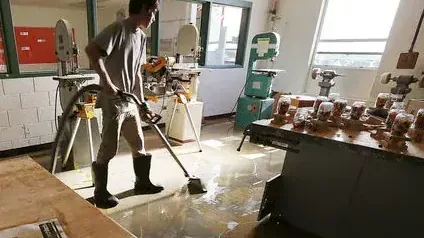
First steps for water extraction and removal in South Lyon
Find the source
Shut off the supply or stop the leak first, since pumping against a running source gets nowhere.
Clear the floor
Lift small items and rugs, and keep foot traffic out of the wet area.
Mind the outlets
Leave power off to wet circuits until they are checked.
Photograph first
Capture the water level and the damaged items before pumping begins.
How a water extraction and removal job is handled
Readings before equipment
The tech who does the walkthrough checks walls, floors and the basement slab with pinless meters and thermal imaging before a single fan is placed.
Dried to IICRC S500
The drying team follows IICRC S500, the industry drying standard, so framing and subfloor get structural drying, not a surface wipe.
A file the adjuster can follow
Moisture maps, daily logs and timestamped photos go into one claim file from the first visit to the last reading.
Built for Michigan winters
Frozen pipes, ice dams, snowmelt seepage and sump pumps that quit in a storm are routine work across Livingston County.
What does water extraction and removal cost in South Lyon, MI?
Extraction alone usually runs $300 to $900 for a small clean-water area and $900 to $2,500 for a basement or several rooms. With full drying added, expect $1,200 to $5,000, depending on the water category and the materials involved.
Small area, clean water
$300 to $900
- One room or a hallway
- Portable pump or wand
- Carpet floated if it can be saved
Basement or several rooms
$900 to $2,500
- Truck-mounted extractor
- Pad pulled and bagged
- Submersible pump on deep water
Extraction plus full drying
$1,200 to $5,000
- Extraction, tear-out and drying
- Dehumidifiers and air movers
- Readings logged for the claim
Ranges are typical, not a quote: water category, wet square footage, material class and how fast drying started move the number most. Run the water damage cost calculator for a closer planning range.
The water extraction and removal process, start to dry
Four stops, run in this order, with a reading logged at each one.
- 1
Assess and stop
The crew finds the source, confirms the water category and checks nearby rooms for spread before a pump starts.
- 2
Extract the water
Truck-mounted units clear the bulk, then portable pumps and wands handle stairs, corners and salvageable carpet.
- 3
Remove ruined material
Soaked pad, insulation and swollen baseboard are bagged so they stop feeding moisture into framing.
- 4
Hand off to drying
Meters and a thermal camera mark what is still wet, and drying equipment follows a daily reading schedule.
South Lyon has 5,155 housing units, from 197 built in 1939 or earlier to 1,661 built in the 1990s, plus downtown buildings along Pontiac Trail and Lafayette Street. Extraction starts the same way in every one of them: find the source, stop it, then pull out the standing water before it moves into the structure.
Equipment matched to the water
Truck-mounted extractors move large volumes off carpet and hard floors, while portable units and submersible pumps reach stairwells, closets and low corners. Weighted wands press water out of carpet and pad when the carpet can be saved.
Wide storefronts with hard floors and finished houses with carpet need different tools, and the crew brings both. In a multi-story building the work runs from the top down so water stops draining into the rooms below.
Questions settled in the first visit
- Is the water clean, gray or black, and can the source be stopped?
- Which rooms, and which floors below, did it reach?
- Can the carpet be floated, or does the pad come out?
- Are outlets or appliances sitting in the wet area?
- Does anything beyond supply water, such as drain overflow, sit in the mix?
Extraction is only the first stage
Pumping removes the bulk, but water that soaked into drywall, subfloors and baseboards stays behind. A thermal camera and moisture meters map those wet areas next, and drying equipment goes in. Pad that cannot be saved is removed and bagged. The structural drying page covers that stage, and basement flooding cleanup covers deeper water in a lower level. Wet vacuums finish the thin films that pumps cannot reach, and a last pass checks corners and thresholds where water pools unseen.
Water Extraction and Removal across the surrounding area
Work covers the whole city, including Downtown South Lyon, the Pontiac Trail and Lafayette Street corridor, the Reynold Sweet Parkway corridor and the blocks around McHattie Park and Volunteer Park, all in ZIP code 48178.
The same service nearby: water extraction and removal in Howell, Brighton, Milford. Every water service for this town · every town covered
Related water damage services nearby
Water Extraction and Removal questions in South Lyon, MI
What is the difference between extraction and drying?
Extraction removes liquid water with pumps and wands. Drying removes the moisture left inside materials using air movers and dehumidifiers, and it takes days rather than hours.
Can carpet be saved after standing water?
Often yes, when the water is clean and the carpet is extracted quickly. The pad underneath usually has to go, and gray or black water means the carpet goes too.
Does extraction cover a flooded basement too?
Yes, with submersible pumps for deeper water. Basement-specific work, from pump-out to wall base drying, is covered on the basement flooding page.
What if the water is already days old?
Older standing water can turn gray or black. The crew tests the situation, removes porous materials that cannot be cleaned and treats hard surfaces before drying begins.
Should anything be moved before the crew arrives?
Lift small items, electronics and rugs onto dry surfaces if it is safe. Leave heavy furniture and soaked carpet alone, because moving them wet can cause injury or damage.
Is water removal covered by insurance?
Sudden losses like a burst pipe are commonly covered, and the crew's photos and readings document the water removal for the adjuster. Coverage always depends on the policy.
Get standing water out before it reaches the framing
A single call sends truck-mounted and portable pumps to the property, followed by moisture mapping and a drying plan built on readings.